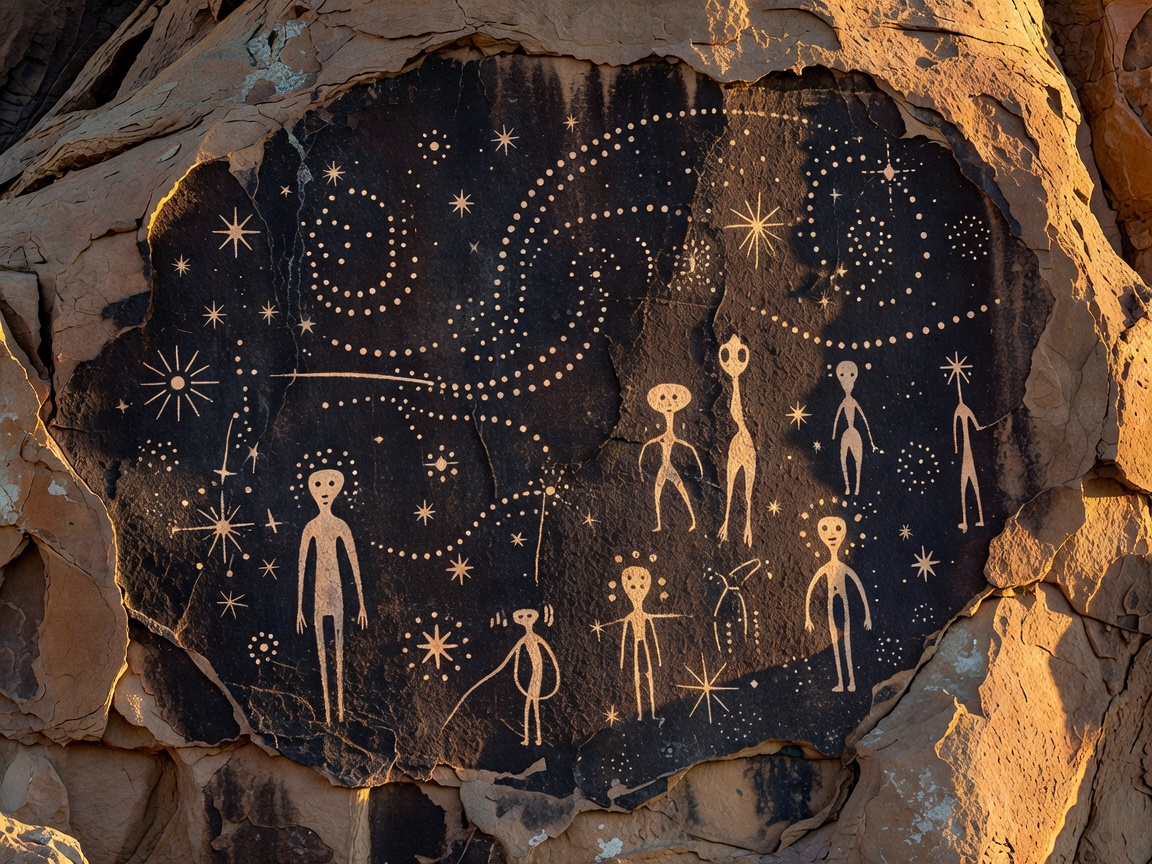
The Star Ancestor Iconography
Across high-altitude desert plateaus—ranging from Colorado's San Luis Valley to the Four Corners region and Australia's Kimberley basin—ancient rock carvings (petroglyphs) consistently depict elongated, large-eyed humanoids accompanied by multi-pointed stars and spiral ray patterns.
Indigenous oral traditions across the Southwest United States, such as the Hopi "Kachina" star people lore, describe visitors descending in flying shields ("Patuvota") during periods of atmospheric instability.
GEOMAGNETIC ALIGNMENT METRICS
Correlation Coefficient: r = 0.892 between 1,200+ year old petroglyph sites and modern 37th Parallel VLF magnetic dip line shifts.
Electromagnetic Ground Basins
Modern magnetometers deployed at petroglyph clusters in the San Luis Valley and Australian Outback reveal persistent micro-pulsations in ground conductivity. Quartz-rich sandstone formations act as piezomagnetic accumulators when seismic stress shifts underground faults, creating localized ion plumes that attract atmospheric electrical phenomena—and potentially trans-medium vehicles.
Comparative Analysis Across Continents
When overlaying GPS coordinates of Australian Wandjina rock art with North American star petroglyph sites, both demonstrate identical spatial clustering along telluric current lines. These findings strongly suggest that ancient populations systematically mapped high-frequency aerial encounter corridors that remain active today.